
Job Openings
To apply for a posted position, please send your cv to team@yetanalytics.com — Thanks!
No current openings
New items, use cases, and new ways of thinking
For the latest regarding learning data, look no further…

As a new advisory offering from the team at Yet Analytics, TDA is focused on helping small and mid-sized businesses, startups, and investors understand the software risk hiding inside rapidly built systems.

Technical Debt Advisors, a division of Yet Analytics focused on helping organizations understand the condition of their software and make better decisions about what comes next. We review codebases, architecture, dependencies, testing, documentation, security practices, maintainability, and AI-development patterns. The result is a clear technical debt score, a prioritized risk inventory, and a practical roadmap for remediation.

On 05 August 2026, Shelly Blake-Plock talked with the Federal Government Distance Learning Association about the new IEEE standard 2247.4 for the Ethical Design and Implementation of AI in Adaptive Instructional Systems.

Now 100 releases into the life of SQL LRS, we have been thinking about what the next 100 should look like.
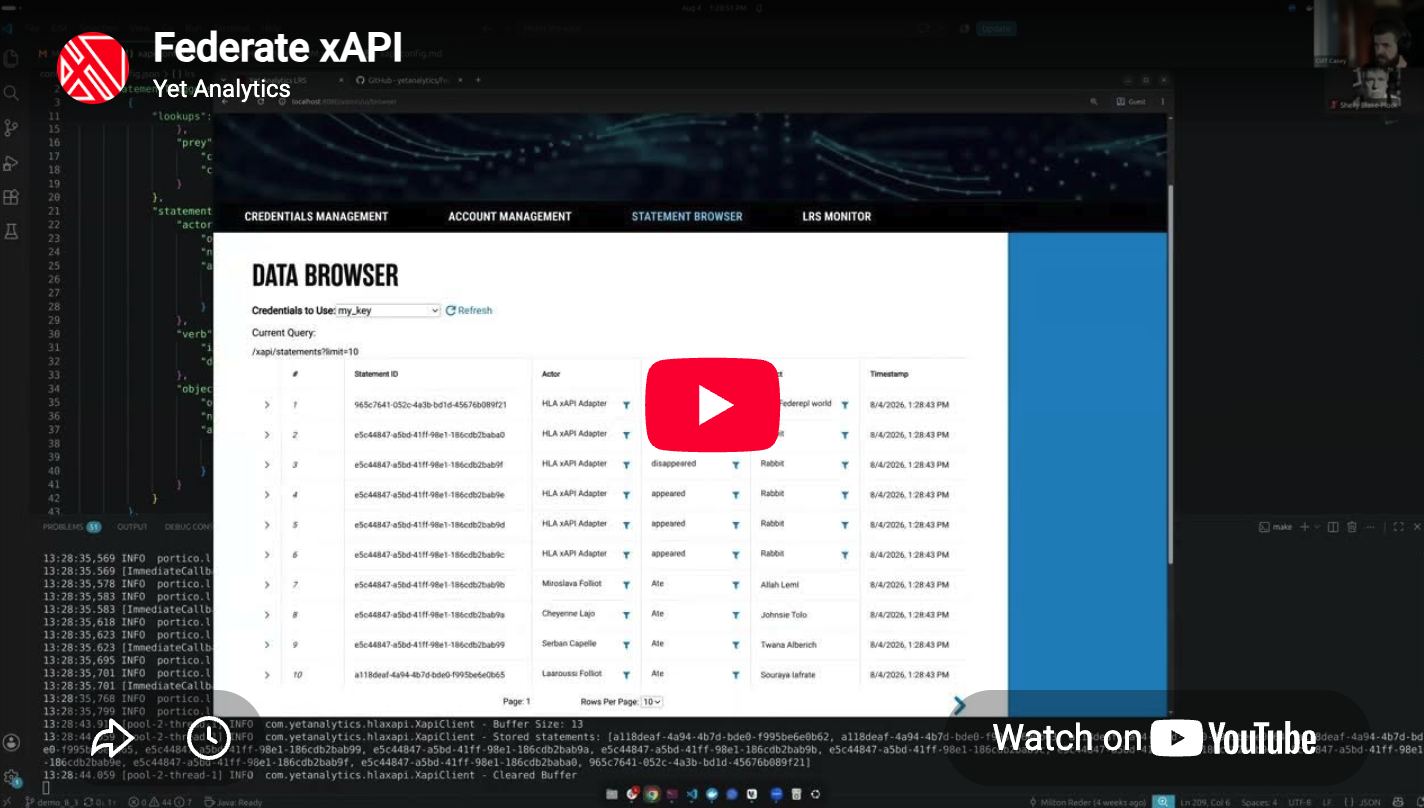
Check out the recap of our 04 August, 2026 webinar on Federate xAPI, the open source bridge between HLA simulations and xAPI.

At Yet Analytics, we have approached data instrumentation from multiple directions: publishing activity natively from Unity applications, translating Moodle platform events, instrumenting media playback in VLC, and observing distributed simulation activity through Federate xAPI. These projects differ in scale and architecture, but they share the same objective to make activity interoperable, accessible, and actionable.
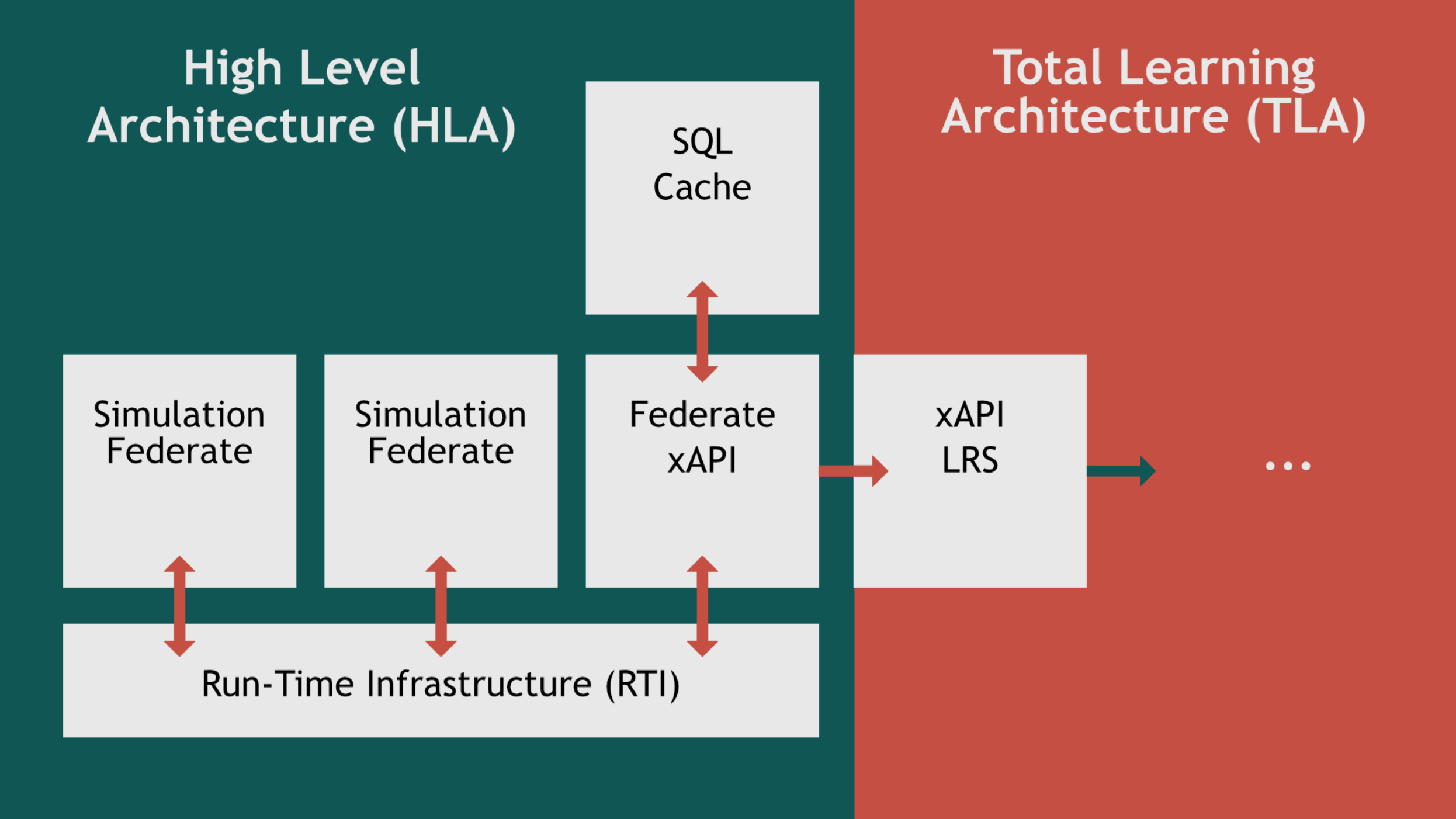
In this webinar, we'll introduce Federate xAPI, an open source capability that bridges HLA simulation and xAPI. Join us for a live demo and conversation.

Federate xAPI is an Apache 2.0 open source HLA federate that transforms simulation activity into Experience API (xAPI) data without requiring changes to your existing simulation federates.

Federate xAPI is a low-code HLA federate that can be added directly to an existing Runtime Infrastructure (RTI) to begin transforming simulation activity into xAPI statements.

Join us on Jul 9, 2026 at 10AM Eastern Time, for a free webinar featuring Jeanine DeFalco, PhD and Shelly Blake-Plock. In addition to celebrating the publication of IEEE 2247.4-2025, the IEEE Recommended Practice for Ethically Aligned Design of Artificial Intelligence in Adaptive Instructional Systems, we’ll be talking about how to leverage ethical frameworks to increase value within organizations.

From industry and workforce development programs, to government and non-profit deployments, to academic rollouts across higher education, we seek to guide organizations in frameworks for the design and implementation of ethical AI that are accessible, meaningful, and actionable. The result will increase value to customers, provide a measurable cultural impact, and present a clear and defensible return on investment.

With ADL now closed, a lot of organizations are facing the same quiet but important question… what happens next?

Most learning data systems were not designed to work together. In some cases, they were actively designed to not work together.

Every organization is talking about AI.
Some are piloting tutors. Some are experimenting with generative feedback. Some are imagining adaptive learning pathways, automated coaching, predictive analytics, and personalized workforce development at scale. But the uncomfortable truth is that most learning data is not ready for AI.
That does not mean organizations lack data. In fact, many have too much of it. They have LMS completion records, assessment scores, survey responses, course metadata, content usage reports, platform logs, HR records, credential data, simulation outputs, and dashboard exports. The problem is not the absence of data. The problem is that most of this data was never designed to work together, and certainly was not meant to be consumed by AI.

Organizations are investing heavily in learning technologies, including LMSs and LXPs, simulations, AI-enabled platforms, immersive environments, and more. The expectation is clear: better training, better performance, better outcomes.
But there’s a problem.
Despite this investment, most organizations still struggle to answer basic questions about their learning systems.

For the team at Yet Analytics, AI in the xAPI ecosystem isn’t a recent addition or a repositioning. It’s been a continuous line of inquiry, development, and application that stretches back more than a decade. We’ve been instrumenting AI systems well before the current moment made “AI-powered” a default descriptor.