Screenshot 2026-02-25 at 3.38.45 PM.png

We interrupt this program

to bring you breaking news

about the implementation of xAPI in your learning tech stack.

Let’s get real about xAPI.

Many people in the learning space still have trouble articulating its value.

Reason #1: Too Early

This is partly because xAPI was ahead of its time and took so long to develop. Many of the published use cases that prospective implementers look at today were completed when today's college students were still in grade school.

Reason #2: Too Meh

A product of its time in the mid-teens, xAPI came to be known for its role in integrations and dashboards. But these days, integrations and dashboards are digital commodities. As a result, it is difficult to make a compelling case for xAPI if that’s the primary purpose.

Reason #3: Too Long

xAPI was originally funded as an R&D activity in 2010. But it took thirteen years for it eventually to become a data standard (IEEE 9274.1). And another two to be adopted by ISO. That’s a very long time to ask a customer to wait on a product.

Reason #4: Too Misunderstood

Despite the fact that xAPI is the perfect data format for AI training on learning events, early POC mishaps have scared off a lot of people who might otherwise use it to unlock their AI capabilities.

But times are changing.

Increasingly, people are using xAPI to create amazing AI-driven applications.

So, we’re going to start documenting some of this work, looking at the variety of ways that innovation is being made at the intersection of xAPI and AI. First up is an application for predicting successful learning outcomes.

Community Highlights in xAPI and AI

Meet INFERable: Predicting Success with xAPI and AI

INFERable's Mastery Practice plug-in works in any LTI-capable learning management system.

The plug-in is powered by AI that uses the xAPI data logged from practice attempts to predict success on the next attempt. It works alongside regular course content to give students the opportunity to practice formative assessment items or performance tasks and it can predict perishability of skills.

Visit INFERable to learn more, and check out learningface.ai for a portfolio of modular AI learning analytics plug-ins that can leverage xAPI data.

xAPI was ahead of its time.

It’s benefit to AI is uncanny — making you the luckiest learning pros ever.

Reason #1: AI Benefits from Structured Data

One of the characteristics of standards-based data specifications like xAPI is that the systems that consume them can know what to expect in terms of the model, format, and attributes. This provides significant advantages in terms of cost and efficiency. And it ensures clean data and less overhead.

Reason #2: AI Benefits from Deterministic Data

Deterministic data represents a ground truth. For AI systems, that means data that can be held in high regard for accuracy and predictability. Leveraged properly, this can improve personalization and increase the relevance of learning interventions.

Reason #3: AI Benefits from Immutable Data

Immutability grants a guarantee of high integrity to data sets used to train AI models — from initial data collection through operational deployment of AI. Because xAPI is an immutable data model, it ensures reliability, reproducability, and security.

Reason #4: AI Benefits from Explainable Data

Because xAPI is standardized, its data attributes are known to systems ahead of time. This ensures an increased degree of transparency and auditability when it comes to explaining why AI has made the decisions it has based on data.

So, this might be a good time

to reconsider the role of xAPI and LRSs. 

And that is why we are happy to re-introduce

SQL LRS, the only Learning Record Store featuring a conditional logic engine that preprocesses data for AI

SQL LRS

Difference Maker #1: Onboard Conditional Logic

Most Learning Record Stores validate and collect xAPI statements. That’s literally what they are supposed to do. Meanwhile, some LRSs add pre-baked integrations and dashboards. Though most enterprises already have these capabilities.

SQL LRS is the only LRS with onboard conditional logic and internal xAPI statement generation — built directly into the platform.

That difference changes everything.

Difference Maker #2: Preprocessing of Data

In the AI era, raw activity data is not enough. Machine learning systems don’t need more logs. They need structured, validated, semantically meaningful signals. They need aggregated completions.

Verified prerequisites. Derived outcomes. Cross-platform performance summaries.

Signal through the noise.

They need preprocessing.

Difference Maker #3: Native Capability

SQL LRS doesn’t just store xAPI statements — it evaluates them in real time.

Its built-in conditional logic engine analyzes incoming activity streams, applies deterministic rules, evaluates multi-step completion logic, and can generate new internal xAPI statements that represent validated outcomes. That means your AI systems receive not fragmented events, but structured behavioral intelligence.

No other LRS does this natively.

Not as an add-on.

Not as external middleware.

Not as custom scripting layered on top.

But natively.

Difference Maker #4: Explainable

Inside SQL LRS, learning data becomes machine-ready before it ever reaches your analytics or AI pipeline.

Because SQL LRS runs directly on SQL, that processed intelligence is immediately available to enterprise tools like Power BI, Tableau, Looker, and any AI stack operating on structured databases. There is no proprietary reporting layer to escape from. No siloed dashboard environment to replace.

Just clean, processed, explainable intelligence.

This matters for organizations where:

  • AI models must be explainable

  • Performance signals must be validated

  • Cross-platform mastery must be verified

  • Certification logic must be deterministic

  • Data integrity must withstand audit

Approach learning data with a sophisticated mindset.

Two Game-changing AI Advantages of SQL LRS

Advantage #1: SQL as a Feature Engineering Engine

Because SQL LRS runs natively in SQL:

  • You can seamlessly migrate into data warehouses and data lakes

  • You can build rolling averages, attempt counts, mastery thresholds.

  • You can join learning data with xAPI data representing HR, operational, or performance.

  • You can normalize and restructure event streams and matters related to identity without exporting.

  • You can use functions to model sequence behavior.

This dramatically reduces friction between data collection and model training.

Your AI team does not need to fight your learning platform to get clean features. They work directly in the most mature data manipulation ecosystem in existence.

That is a massive enterprise advantage.

Advantage #2: SQL as an Agent Interface

Agentic systems operate best when:

  • The schema is known.

  • The query language is structured.

  • The output is deterministic.

When learning data lives in SQL:

  • Agents generate SQL queries.

  • The database returns precise rows.

  • Output generation is grounded in controlled data retrieval.

This is far more stable than agents scanning documents, files, or loosely structured JSON blobs. It also allows security policies, access control, and auditing to remain intact at the database layer.

In other words, SQL LRS makes learning data agent-ready.

This must cost a bundle, right? No. SQL LRS is distributed under the Apache 2.0 license.

Always open source. Always free.

Get it on GitHub

Get it on Docker

Get it on IronBank

Let our team set it up

Okay. You’re convinced

and now you want to know how to make this happen. 

So, how does this all work?

You’re welcome to roll your own SQL LRS for free. But if you need help, we provide these services.

Service Package #1:

Advisory

Our team has experience in needs analysis and project requirements, data modeling and design, standards alignment and AI-readiness, and of course our expertise — data architecture. We are considered the leading engineering group for the standards-based Total Learning Architecture and have provided services for governments and for Fortune 500 companies.

In our advisory role, we support your team as it makes decisions about the implementation of xAPI and related data capabilities including learning metadata, machine-readable competencies, and enterprise learner records. We also have significant experience in the ethical design of artificial intelligence for learning environments (we helped write the IEEE standard on Ethical Design of AI for Adaptive Instructional Systems).

We find it easiest to work on retainer and on projects that can be chunked into quarterly deliverables. We’ve worked on projects as brief as 90 days and as long as 36 months. Get in touch and let’s discuss if our advisory services are right for you.

Service Package #2:

Augmentation

Some projects demand dedicated software engineering services with hard-to-find knowledge. If you find yourself in this position regarding xAPI or any element of the TLA, we can provide engineering staff to join your team to get the job done.

Consider us to be an engineering A-Team that you can drop into a project without having to go through the hassle of finding programmers with the skills and background to take on the novel and finicky issues that separate successful enterprise xAPI implementations from money pits.

We have worked this way on major learning infrastructure projects, usually for governments. We would be happy to discuss options and provide a proposal that meets your budget and scope.

Service Package #3:

Support and Maintenance

We provide enterprise-level support for all of our open source software, including SQL LRS. No matter the environment — on the cloud or on-prem — we have the experience to provide peace of mind that your learning data infrastructure is working as intended.

We have extensive experience deploying and maintaining our code base in highly secure DevSecOps environments. And we also have experience supporting non-traditional requests such as supporting applications in harsh offline environments. In fact, SQL LRS itself was originally designed for offline use for data collection during remote training exercises.

Get in touch and we can discuss your needs and whether or not you’ll need implementation support as well.

You could say that we are experienced.

If it relates to xAPI, we’ve probably dealt with it. And if we can’t do it, we’ll point you to who can.

Experience and Assurance

Yet Analytics designed the first commercial LRS to pass the ADL’s LRS Test Suite — back in 2015. Since then, we’ve led the way in xAPI research with projects spanning from data simulation to AI-enabled synthetic training environments.

SQL LRS has attained certifications for high security DevSecOps environments, including a cATO during ADL’s work on the Enterprise Digital Learning Modernization effort. It has been tested and pummeled with billions of xAPI statements. As an Apache 2.0 open source project, it will celebrate its 100th release in 2026. It’s been pulled over 50,000 times on DockerHub. It is rugged and maintained by a team who has more experience building xAPI for SQL than any other team on the planet.

We are purposefully discrete in how we discuss prior work and endeavor to honor the privacy wishes of our customers. We are always happy, however, to present work that we’ve done together with clients, especially through the publication of research.

Instrumenting Gov and Edu with xAPI

Government: Provided data instrumentation and secure SQL LRS support for the Enterprise Digital Learning Modernization project at ADL and team augmentation to support development of a fully instrumented Moodle LMS for government use.

Higher Education: Provided xAPI data instrumentation advisory services to the NYU Media Center’s XR Edtech Accelerator program.

K12: Provided xAPI data instrumentation and reporting capabilities supporting a large public K12 district grant and provided a tech inventory and integration review for a large charter school network.

Knowledge of xAPI in Regulated Industries

Aviation: Provided xAPI data instrumentation advisory services for commercial pilot training programs at the largest airplane manufacturer in North America.

Healthcare: Provided xAPI data instrumentation advisory services for a major healthcare learning management system and provided advisory for xAPI implementation at a large metro nursing school.

Emergency Medical Services: Provided xAPI data instrumentation and team augmentation for hybrid medical simulations in partnership with George Mason University, ADL, Inova Hospital, and Fairfax County Fire and Rescue.

Oh, and about the Total Learning Architecture…

Did we mention, we have software capabilities for the entire TLA?

LRSPipe

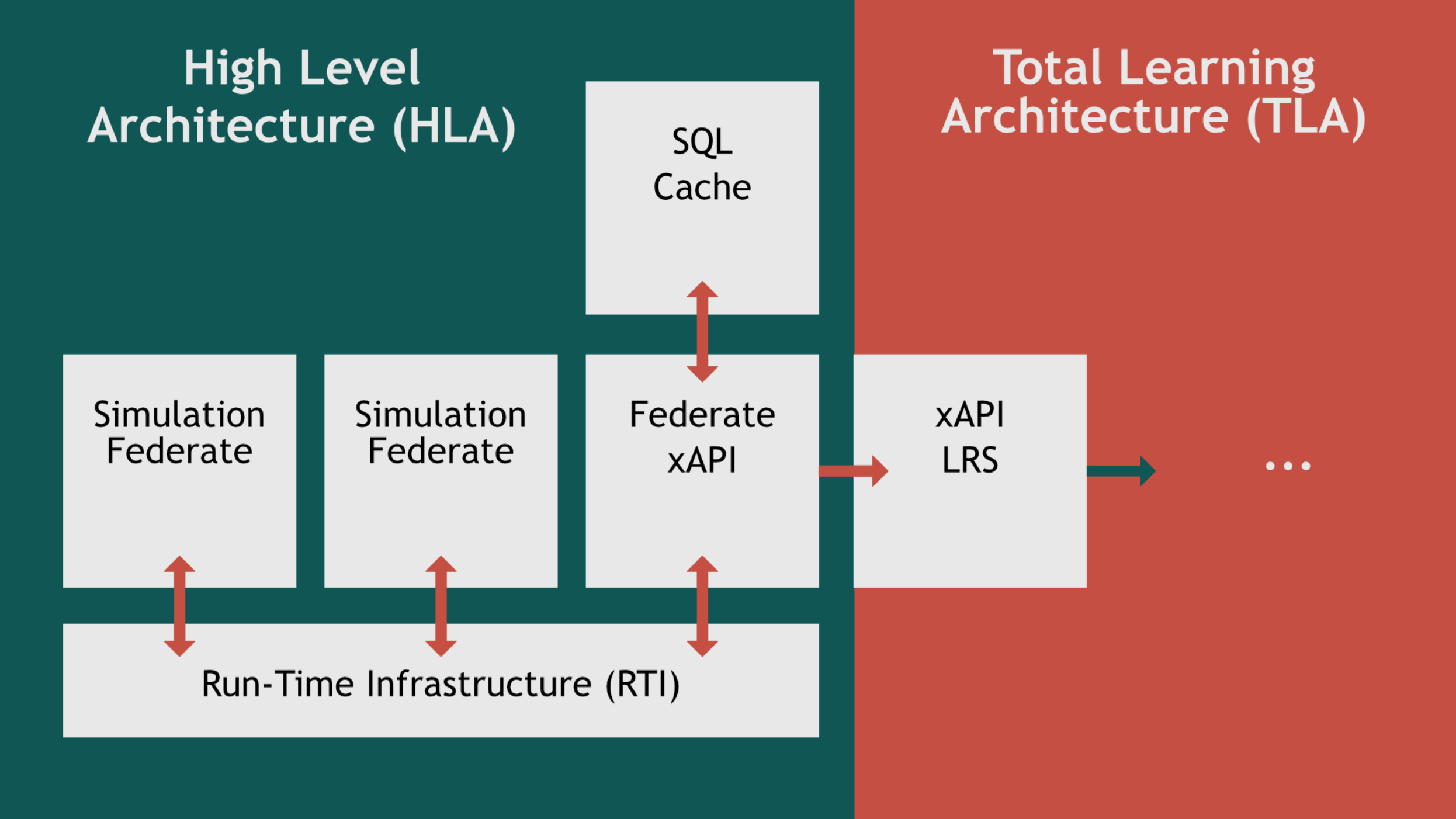
An ingenious data forward-filter that can use the patterns of an xAPI Profile to send specified data through the TLA, this open source process has become the standard way to deal with xAPI data flow between noisy and transactional LRSs. It’s available on Github.

Centriph

An advanced xAPI Profile authoring application paired with a robust profile server, Centriph is the only capability that includes full data validation for profiles and xAPI templates. It’s built to be used in visual mode or at code-level.

DATASIM

More xAPI data has been generated via this application that by any other. Built for stress-testing learning infrastructure, DATASIM is a synthetic modeler and generator capable of producing billions of deterministic xAPI data statements following the patterns available in xAPI Profiles.

XI & ELRR

An Experience Index (XI) is a repository for learning metadata following the IEEE 2881 standard. An Enterprise Learner Record Repository is a state-based data store governed by the IEEE P2997 standard activity. Both open source capabilities are requisites for building out a fully mature TLA ecosystem.

Winner of the Nielsen Data Visionary Award at TechCrunch Disrupt

We’ve been working on this for a while.

Where you may have heard from us…